
Studio Stellavato
Our HistoryFrom two to three-dimensional: why I crossed over into interiors
“A room should feel like a portrait of the person who lives in it — bold, refined, and deeply personal.”
— Nadine Stellavato Brown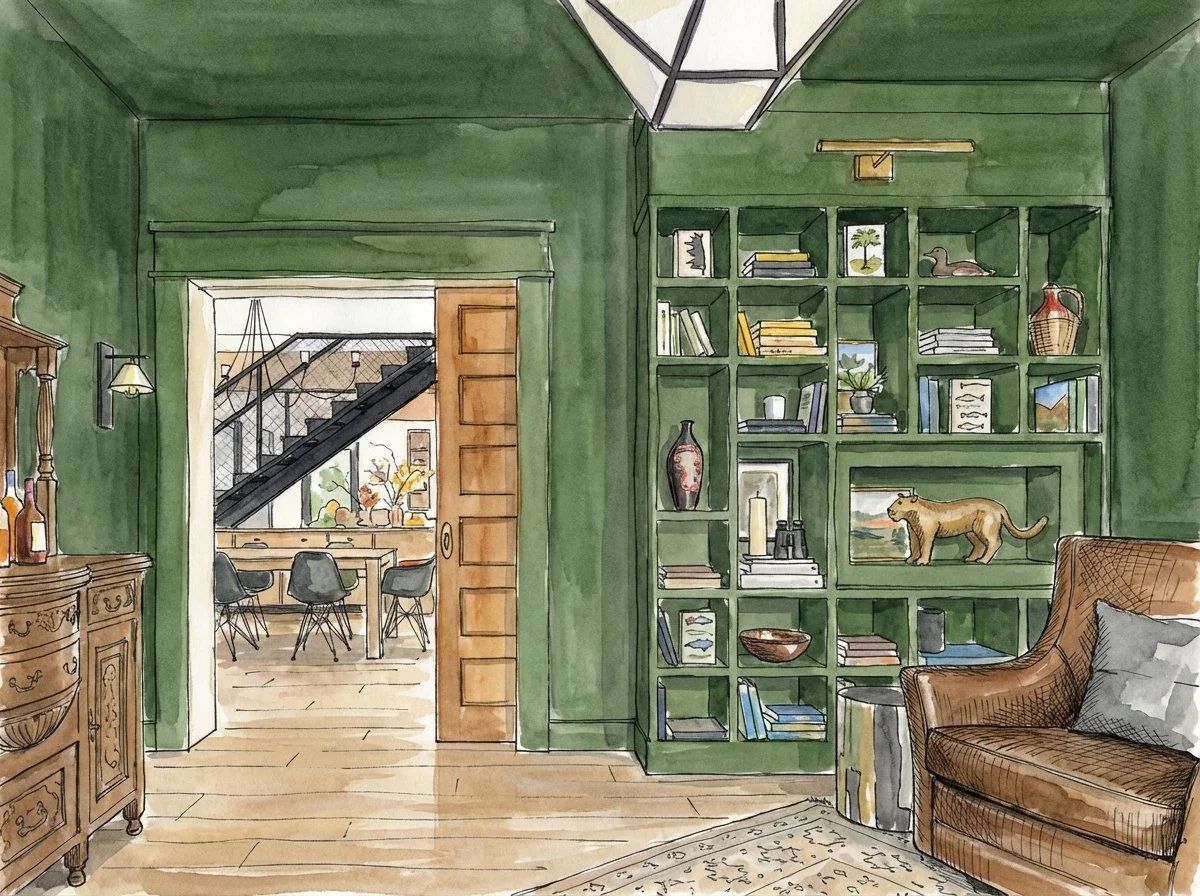
design hackDon’t be intimidated by color.
Color is the thing that stops most people in their tracks — and I completely understand why. Committing to a wall color feels permanent and high-stakes. But here's what I tell every client: if you're unsure about a room's color, don't start with paint swatches. Paint a large canvas in that color first, hang it in the room, and live with it for a few days. Watch how it changes in the morning light versus the evening. See how it feels on a tired Tuesday versus a relaxed Sunday. Color is never just color — it's light, time, and mood all at once. The canvas lets you audition it before you commit. Trust the process, and trust yourself.
People who know my background as a creative director and branding designer often wonder how I ended up in interior design. The honest answer is that I was always thinking about it — I just didn't have the language for it yet.
For thirty years, my work was about creating experiences. Not just logos or color palettes, but the feeling a brand gives you when you walk into a room, open a package, or land on a website. I was always asking: what does this communicate? How does it make someone feel? At some point I realized I was asking those exact same questions about spaces. And I thought — why am I only working in two dimensions when the most powerful experiences happen in three?
The moment that planted the seedThere are a few moments I look back on, but one has always stayed with me. My very first graphic design boss asked me to help design his house. I remember how fun it was — how completely natural it felt. The same instincts I used at work, the same eye, the same questions, they all just translated. I wasn't struggling. I was playing.
I'd been doing the same thing for family for years without thinking twice about it. A sister's living room here, a parent's kitchen there. It just felt like helping. It never occurred to me until much later that what came so easily to me could genuinely be of value to others. That's a funny thing about the skills we're most naturally gifted with — we tend to take them for granted because they don't feel hard. That moment planted a seed that took a long time to grow, but it never really left me.
Where branding meets interior designMy background in branding changes the way I approach a room in almost every way. When I start a branding project, I don't open a sketchbook first — I ask questions. Who are you? What do you stand for? What do you want people to feel? I bring that exact same process into interiors. Before I choose a single finish or piece of furniture, I want to understand the person. Their story. The life they've built. The version of themselves they want to come home to.
A room should feel like a portrait of the person who lives in it.
Then the design becomes a translation of all of that — color, form, texture, spatial flow — into something physical and liveable. That's what it means for a space to communicate identity.
2D meets 3DWhen I talk about the relationship between 2D and 3D design, I mean it quite literally. Typography shapes how you move through information. Color on a flat page still creates mood, depth, and temperature. Composition in a brand layout is the same skill as composition in a room. I spent thirty years training my eye and my instincts on a two-dimensional canvas. Walking into spatial design, I wasn't starting over. I was going deeper.
The canvas got bigger — literally. And now it's one you walk through, live in, and wake up inside of every single day. The spaces we inhabit shape us just as much as we shape them. Getting to be part of that is why I'm here.
Who I love working withMy favorite clients are people who have worked hard to get where they are. That's not about a price point or a zip code — it's a mindset. When someone has truly built something, whether it's a career, a business, a family, or a home, they understand that the things worth having take time and intention. They don't want fast. They want right.
When someone trusts me with their space, they're trusting me with something deeply personal. I never forget that. Their investment deserves thoughtful design, real storytelling, and a partner who works just as hard as they do. That's the standard I hold myself to, every single project.
What I hope you feelWhen someone comes home to a space I've designed, I don't want them to feel impressed. I want them to feel recognized. Like the space sees them. Like it was made specifically for who they are and how they live — because it was. That feeling of walking in and exhaling, that's always the goal. Beautiful, yes. Refined, always. But above all, deeply and unmistakably theirs.